I’m running a Greddy MX (2.5 inch mandrel piping with OBX 2.5 inch test pipe
will this be ok for t3/to4 turbo?
I know that 3 inch is ideal…
but will I be ok with 2.5 inch?
I’m running a Greddy MX (2.5 inch mandrel piping with OBX 2.5 inch test pipe
will this be ok for t3/to4 turbo?
I know that 3 inch is ideal…
but will I be ok with 2.5 inch?
2.5" will be more than ok…you won’t make use of 3" until you get over 500hp
yup
2.5 worked great for me… 3.0 isn’t really ideal. just depends on ur setup, and how much power ur puttin out
woohoo! thanks guys!!!
 :burnout:
i have seen before & after dynos of 2.5" exhaust piping vs. 3" piping. even at low boost/hp levels like 8psi/250hp you can gain 10 - 20whp.
10-20WHP from going 3inch??
even at 7psi?
yups
that 10-20 hp increase is possible… with a larger exhaust, there is greater chance of boost creep
How about with 2 1/4 piping? I have a thermal research exhaust cat back with is 2 1/4 i believe correct? I want to run 7-8 psi like touring teg. Any ideas - Will it harm me much becuse I would like to keep it as is.
3" exhaust will definately benefit you at 7psi. 2.25" and 2.5" is sufficent if that’s what you already have, though.
hmm…ok
who wants to trade there thermal 3inch for my greddy mx 2.5 inch 
Originally posted by integracon
3" exhaust will definately benefit you at 7psi. 2.25" and 2.5" is sufficent if that’s what you already have, though.
I disagree…3" is overkill…
I don’t see how it could be over kill. I ran my car with my 2.25" exhaust- trapped at 102MPH and with open downpipe pulled 104MPH at the same psi, the same day. Haven’t ran with my 3" yet, but I’ve heard many testiments that it’s alot more responsive than 2.25" Dyno’s are the only REAL way to tell…
boost response and higher peak hp are 2 different things…
haberdasher, explain to me why backpressure is better for low-end response on a turbo car?
and rob, check yer e-mail buddy…
Originally posted by qwkteg125
[B]haberdasher, explain to me why backpressure is better for low-end response on a turbo car?
[/B]
ditto… will it spool faster with smaller piping?
OK…I had to toss my apartment to find the book that had the info and then toss it again to find a parallel cable to hook up my scanner…so I hope you appreciate it…
This info is from “Maximum Boost: Designing, Testing, and Installing Turbocharger Systems” by Corky Bell
“It is easy to get overeager on fitting large-diameter pipes into an exhaust system. “The larger the better” is not the case. As indicated in Chapter 5, there is an exhaust gas velocity that ought not to be exceeded. I am going to suggest that for exhaust calculations, this velocity is approximately 250ft/sec. The considerable expansion of exhaust gas due to the temperature increase also requires a significant increase in the desired volume of the tailpipe. The tubes for the hot gas on the exhaust side should therefore be larger than the tubes for the cooler intake side. Base the calculation on the same conditions as for intake tubes, but use a maximum velocity of 250 ft/sec rather than 450 ft/sec. To size a tailpipe, you can adhere to this exhaust gas velocity or to the simple guideline of selecting a tube diameter approximately 10% larger than the turbine outlet diameter. Figure 11-4, exhaust tube size versus bhp, offers a good guide to choosing an adequate tailpipe size.”
Equations:
multiply the desired bhp by 1.5 to get exhaust flow value
Let power = 250 bhp for which max exhaust flow is approximately 375 cfm (250 * 1.5)
Let exhaust tube diameter = 2.5 in
375 ft^3/min / pi(2.5/2) ^2 in.^2 * 1/60 min/sec / 1/144 ft^2/in.^2 = 183 ft/sec
As you can see 183 ft/sec is considerably lower than 250 ft/sec so we’re in good shape…we have room to increase hp with this size pipe.
Now lets see what happens with 3" pipe
Let power = 250 bhp for which max exhaust flow is approximately 375 cfm (250 * 1.5)
Let exhaust tube diameter = 3 in.
375 ft^3/min / pi(3/2) ^2 in.^2 * 1/60 min/sec / 1/144 ft^2/in.^2 = 127 ft/sec
Wow…look how far we are from 250 ft/sec! All that increased capacity isn’t doing a thing except making our wallets thinner!
We can further confirm this with the 10% larger than the turbine outlet diameter rule. A T3 exhaust housing on a T3/TO4E turbo, the largest any of us is using I believe, has an outlet diameter of 2.11". 10% of 2.11 is 0.211 Add that to the 2.11" housing diameter and you get an ideal tube diameter of 2.321"
Now run 2.321" through the equation…we get 212 ft/sec
We can further confirm our findings with the following chart:
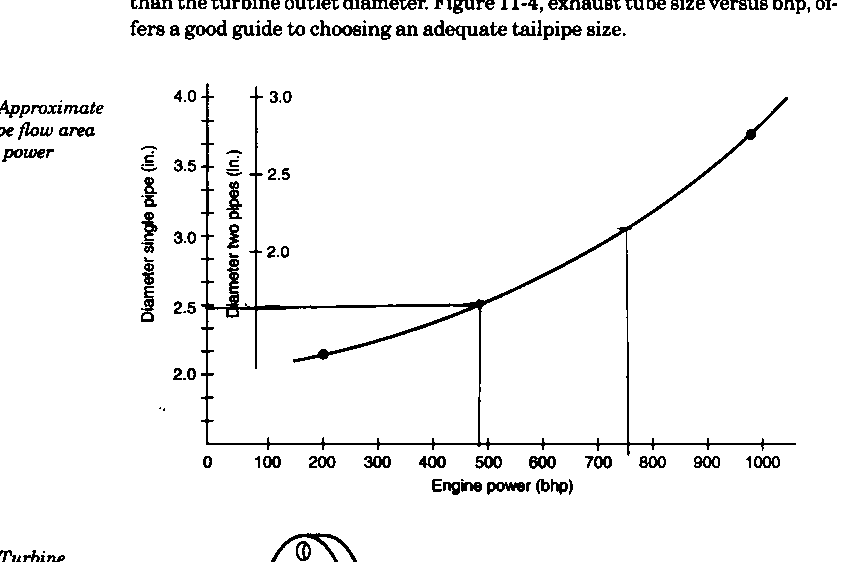
If you plot 250 bhp on it you will get a pipe diameter of approximately 2.3….which is what we found with the equation.
I’d rather trust the math than dyno runs and track runs that only vary by 1 or 2 hp/mph between pipe diameters. Those variances can be explained by everything from weather conditions and the person running the dyno.
Who wants to come over and help put my apartment back together?
thank you very much I definitely appreciate it!
ok i can’t really understand that formula without correct parenthesis but it looks like if we follow that chart you posted, then 2.25" piping would be super ideal for a 250hp turbo setup. now if you believe this, then you are truly in the dark when it comes to real world proven testing. corky bell has a lot of good things to say i admit, but how can you take one man’s word 100%? if the import world thought like you, we would have never seen the 8 sec imports we have now. instead, it would be a world of 10 sec racers, who’d pick supposedly “ideal” turbos solely on reading compressor maps, run puny exhausts, & not have wheelie bars.
bottom line, i’ve never seen a dyno graph showing a turbo honda losing power anywhere in the powerband merely by switching to a 3" exhaust. and the difference is more then a mere 1-2hp like you state…
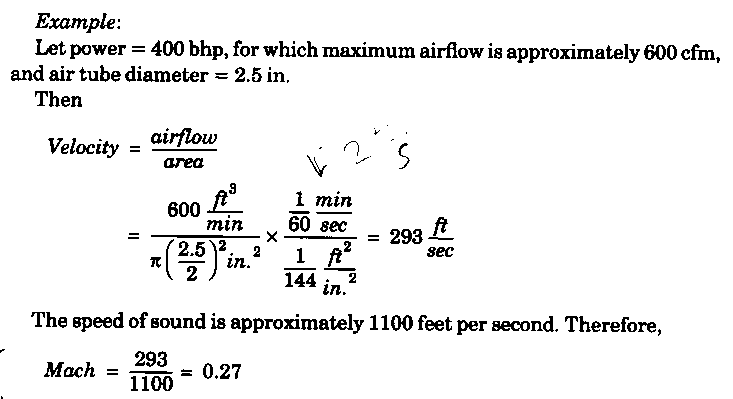
Real world proven testing? I haven’t seen any dyno charts that show huge gains from 3" over 2.5", in this thread or otherwise. I’d rather take the results of these equations that use known laws of physics than some magazines photoshopped dyno chart. Don’t forget that magazines rely on advertising funds to make money. Turbo magazine isn’t going to run an article where some modification results in disappointing numbers if they want to keep the company that made the product as an advertiser. It’s well known that magazines alter test results and dyno charts, not to mention parts manufacturers altering numbers.
We all know that the world of racecars and the world of streetcars are two different worlds, I’m pretty sure we’re talking about the world of streetcars here.
Granted no car has lost power from switching to a larger diameter exhaust. I never said that that would happen. But why spend the extra money to have the extra diameter if it’s never going to be used?
When doing research for our turbo systems we need to constantly ask ourselves why the norm is considered the norm? Is it because some magazine said so? Is it because some guy at the street races said so? Is it because some manufacturer said so? What is the basis for these conclusions? I see a world where everyone does what everyone else did before. Every once in a while someone colors outside the lines and we get things like wheels bars on imports, or someone running a different turbo than everyone else because the compressor maps says it’ll be more efficient. Hell, we got import racing because someone wanted to try something different from the norm.
Don’t give in to the status quo. Have the courage to do something different. If you’ve done the research, and that research has convinced you to do something outside the norm, then nobody has the right to tell you that you’re wrong.
:werd: difference between popularity and performance